Written by Sam Castor, Esq., Lex Tecnica Founder and Attorney
Lex Tecnica | Southern Nevada Water Policy
Seventeen parks.
That number caught my attention.
Buried in the Southern Nevada Water Authority’s agenda is an interlocal agreement with the City of Las Vegas involving turf conversion at 17 public parks.
The projected water savings?
252 acre-feet every year.
That’s roughly 82 million gallons of water.
Sounds great.
But here’s the question nobody seems to be asking:
What are we giving up to save it?
I am not anti-conservation. Far from it. We live in the Mojave Desert. Water is precious. The Colorado River is under tremendous pressure, and Southern Nevada has to be thoughtful about how we use the resources we have.
But thoughtful is the operative word.
Good policy requires more than counting gallons.
It requires counting consequences.
Las Vegas Parks Turf Conversion: What’s Actually Useless?
For years, Southern Nevadans have been told we need to eliminate “useless grass.”
I have a problem with that phrase.
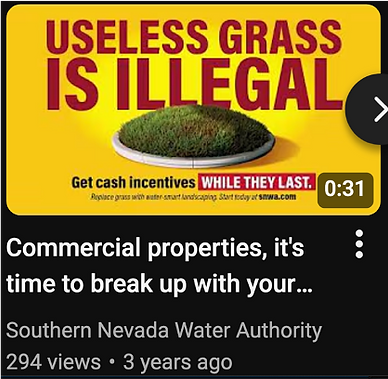
Because who decides what is useless?
Grass along an eight-lane roadway that nobody walks on? Fine. Let’s have that conversation.
But grass in a neighborhood park?
Grass where kids play soccer?
Where families throw Frisbees?
Where someone sits under a tree with their dog on a July evening?
That doesn’t sound particularly useless to me.
Interestingly, it doesn’t appear to sound useless to SNWA either.
SNWA recognizes recreational turf as functional and says grass used for sports, exercise and picnicking has a legitimate purpose. The agency estimates approximately 7,600 acres of grass at parks, schools and sports fields throughout the Valley are used for recreation.
So if we’re converting turf at 17 Las Vegas parks, I want to know exactly what we’re removing.
And I think the public deserves to know too.
You Can’t Measure a Tree in Gallons
There is another number we need to talk about.
Trees.
Southern Nevada’s mature trees did not magically appear.
Some have been growing here for 20, 30, 40 or even 50 years. Their root systems adapted to the environments we created around them, including decades of irrigation from lawns.
Then we decided the grass had to go.
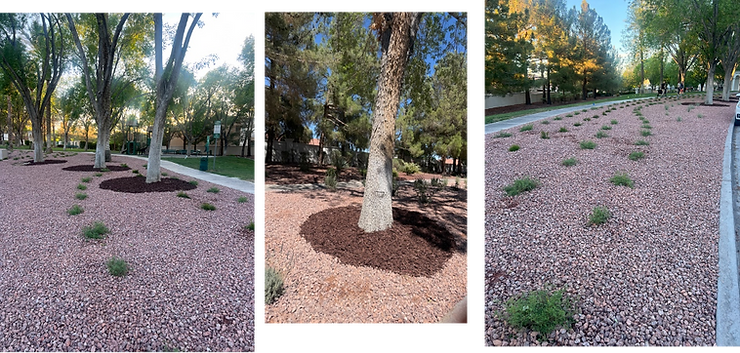
Rip it out. Change the irrigation. Put down rock.
And then we act surprised when trees struggle.
Litigation challenging Southern Nevada’s turf-removal policies alleges that conversions have contributed to the loss or severe stress of more than 100,000 mature trees across the Valley, with hundreds of millions of dollars in estimated tree-loss damage.
Think about that for a moment.
We are removing grass to protect the environment.
But if doing so kills the trees that shade our homes, cool our neighborhoods, stabilize our soil and make this desert city livable, have we actually conserved anything?
Or have we simply moved the environmental cost from one column of the spreadsheet to another?
Las Vegas Doesn’t Need More Heat

Walk barefoot across grass in July.
Now walk across artificial turf.
Or decorative rock.
Actually, don’t.
You get the point.
Living landscapes cool their surroundings. Trees provide shade. Vegetation changes the microclimate around homes, sidewalks and gathering spaces.
Rock doesn’t.
Artificial turf doesn’t.
And Las Vegas already has enough heat.
SNWA itself encourages trees as part of turf conversions and recognizes their value in shading buildings and ground surfaces.
Good.
Then let’s take that principle seriously.
Before grass is removed from these 17 parks, the public should know how many mature trees could be affected, how their irrigation will change and who will be responsible for monitoring their health.
Not for six months.
For years.
Because a mature tree may take decades to replace.
A Park Isn’t a Water Meter
This is where government policy often goes wrong.
We identify something we can measure.
Then we optimize the heck out of it.
Gallons saved.
Square feet converted.
Dollars rebated.
Acre-feet conserved.
Those numbers matter.
But people don’t live in spreadsheets.
They live in neighborhoods.
And a park isn’t simply an irrigation account.
A park is where a five-year-old learns to throw a baseball.
It’s where teenagers play soccer.
It’s where grandparents walk in the morning.
It’s where families hold birthday parties.
It’s where people go when they need somewhere outside their house to simply be.
That value is harder to put into a spreadsheet.
But that doesn’t make it less real.
Conservation Should Be Human-Centered
There is a strange tendency in government to treat people as obstacles to policy rather than the reason policy exists.
That’s backwards.
If we’re going to spend public money converting public parks, the people who use those parks should have a meaningful voice in what happens to them.
Show us the plans.
Show us exactly which turf is disappearing.
Show us what replaces it.
Show us the tree-preservation plan.
Show us the projected temperature impacts.
Show us how much recreational space remains.
And then ask the people who actually use the park:
Does this make your neighborhood better?
That’s collaboration.
That’s transparency.
That’s how public policy should work.
82 Million Gallons Is a Lot of Water
Let’s be fair.
Saving approximately 252 acre-feet annually is meaningful.
Roughly 82 million gallons of water every year deserves our attention.
Southern Nevada has also accomplished something remarkable: we’ve dramatically reduced per-capita water consumption while adding hundreds of thousands of residents.
We should continue doing that.
But conservation cannot become a religion where every gallon saved automatically justifies every consequence created in saving it.
Water matters.
So do trees.
So does shade.
So does recreation.
So does community.
And so does the public’s right to ask questions when government agencies decide to fundamentally change public spaces.
Las Vegas was named “the meadows.”
Maybe there’s some wisdom in remembering that.
We don’t need to turn the Mojave Desert into Kentucky.
But neither should we become so obsessed with eliminating green space that we forget why people planted trees, built parks and created places for families to gather in the first place.
So yes, let’s save water.
Let’s save 252 acre-feet if we can.
But let’s ask one more question before the grass disappears from 17 Las Vegas parks:
Are we conserving the resource while destroying some of the things that make the resource worth conserving in the first place?
Because conservation isn’t just about using less.
It’s about protecting what matters.

About the Author
Sam Castor, Esq. is the founder of Lex Tecnica and an attorney and technology executive with more than 15 years of experience navigating complex business, technology, regulatory, and legal matters. He has negotiated billions of dollars in intellectual property and infrastructure transactions and brings a practical, solutions-focused approach to law, policy, and business.